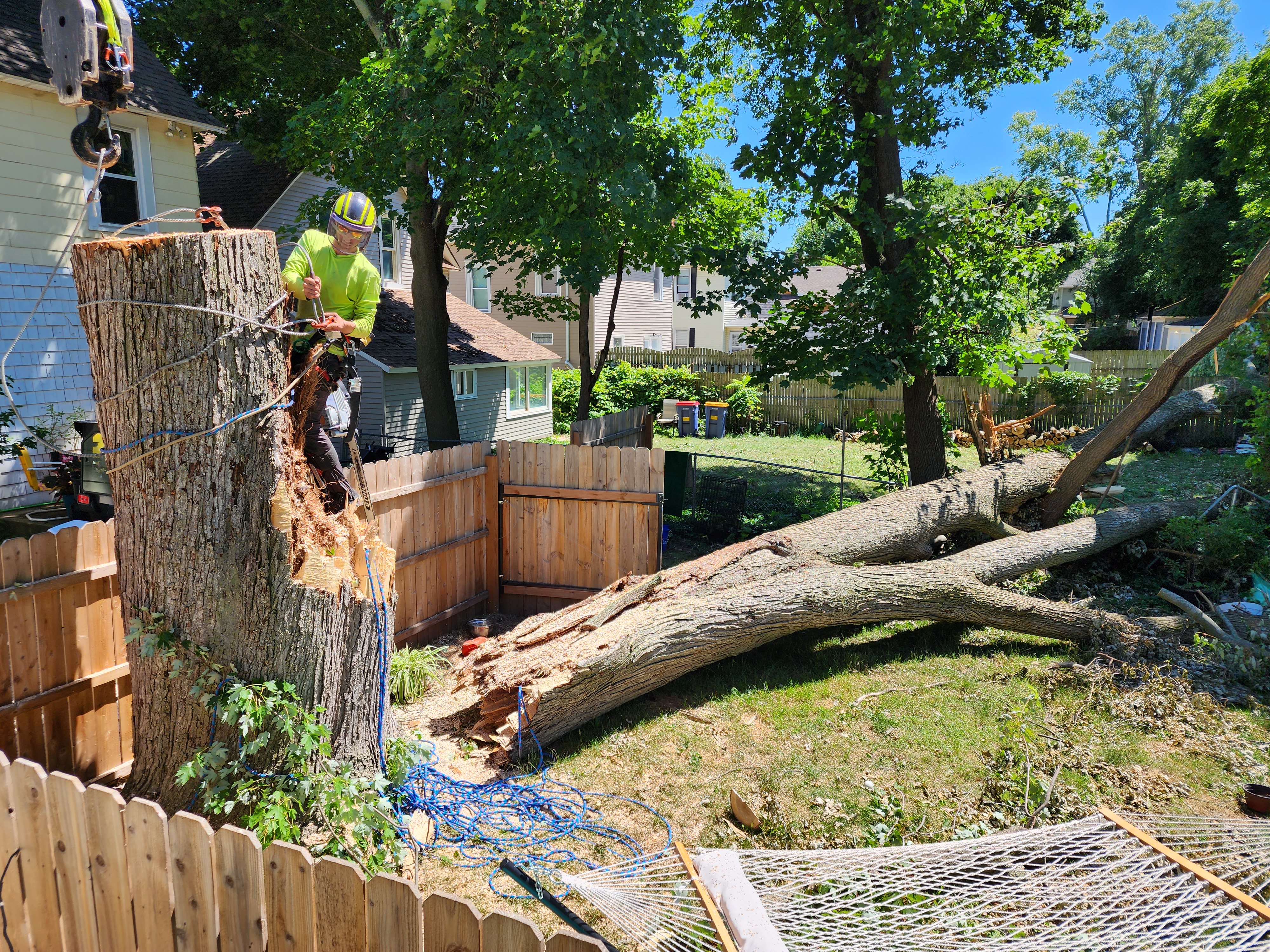
West Michigan storms don't hold back. Straight-line winds, microbursts, ice loading, and heavy snow — Grand Rapids trees take a beating. After the storm passes, you're left staring at broken limbs, leaning trunks, and torn canopies wondering: is this tree done, or can it come back?
As an ISA Certified Arborist (MI-4776A), I assess storm-damaged trees across the Grand Rapids area regularly. Here's the framework I use to decide whether a tree should be saved or removed.
The 4 Factors That Determine a Storm-Damaged Tree's Future
1. Crown Loss: How Much Canopy Is Gone?
If a tree has lost more than 50% of its crown, recovery is unlikely. The crown is the tree's engine — it produces food through photosynthesis. A tree with half its leaves gone is running on empty. It may push out new growth, but that growth will be weak, poorly attached, and prone to failure in the next storm.
Trees that lost 25–50% of their crown are borderline. Species matters here — oaks and maples are more resilient than ashes and willows. A certified arborist can assess whether the remaining structure can support healthy regrowth.
2. Trunk Integrity: Is the Main Stem Cracked?
Trunk cracks are serious. A vertical split running down the main trunk often means the tree's structural integrity is compromised beyond repair. Horizontal cracks, large bark strips peeled away, or cavities exposed by broken branches all reduce the trunk's ability to bear the weight of the crown.
If the trunk is intact but major scaffold branches have broken off, the tree may be saveable through restoration pruning — but it depends on where the breaks occurred and how much wound surface is exposed.
3. Root Stability: Has the Root Plate Lifted?
A leaning tree with heaved soil on one side is an emergency. When roots pull out of the ground, the tree has lost its anchor. Even if the tree hasn't fallen completely, a partially uprooted tree can topple without warning — especially in saturated soil after rain.
Small trees (under 6" trunk diameter) that have tipped can sometimes be righted and staked if the root ball is mostly intact. Larger trees with root plate failure need removal.
4. Location and Risk: What's the Tree Near?
A damaged tree in an open field is a very different situation than a damaged tree hanging over your bedroom. Proximity to targets — houses, driveways, play areas, power lines — determines urgency. A tree that might be worth monitoring in a back woodlot becomes a removal priority when it's 20 feet from a structure.
Trees That Usually Survive Storm Damage
- Lost a few branches but the main trunk and scaffolding limbs are intact
- Crown loss under 25%
- No trunk cracks or root heaving
- Species with strong compartmentalization (oak, hickory, black walnut)
- Young trees that can be reshaped through structural pruning
Trees That Usually Need Removal
- Crown loss over 50%
- Trunk split or major vertical crack
- Root plate heaved or partially uprooted
- Already in decline before the storm (fungal conks, dead branches, sparse crown)
- Species prone to weak wood (silver maple, Bradford pear, willow)
- Hanging over a house, driveway, or high-traffic area
What to Do Right After the Storm
- Stay away from downed power lines — even if a tree is touching a line that appears dead, treat it as live. Call Consumers Energy at 800-477-5050.
- Don't go under damaged trees. Hanging branches ("widow-makers") can fall without warning.
- Document damage with photos before anything is touched. Your insurance company will want this.
- Call a certified arborist for a professional assessment. Resist the urge to hire the first truck-and-chainsaw crew that knocks on your door after a storm — storm chasers often do more harm than good.
Why You Need a Certified Arborist After a Storm
Storm chasers — unlicensed crews who show up uninvited after big storms — are a real problem in the Grand Rapids area. They'll offer low prices for fast work, but they're often uninsured, unqualified, and leave behind flush cuts, torn bark, and stub branches that invite disease and decay.
An ISA Certified Arborist assesses the whole tree, not just the broken part. We look at pre-existing conditions, species-specific recovery potential, and long-term structural viability. Sometimes the best answer is restoration pruning. Sometimes it's removal. The wrong call costs you a tree — or worse, a repeat failure.
Need a storm damage assessment? Call B's Trees at 616-947-4050. We serve Grand Rapids, Kentwood, Wyoming, Ada, Rockford, and all of Kent and Barry County.