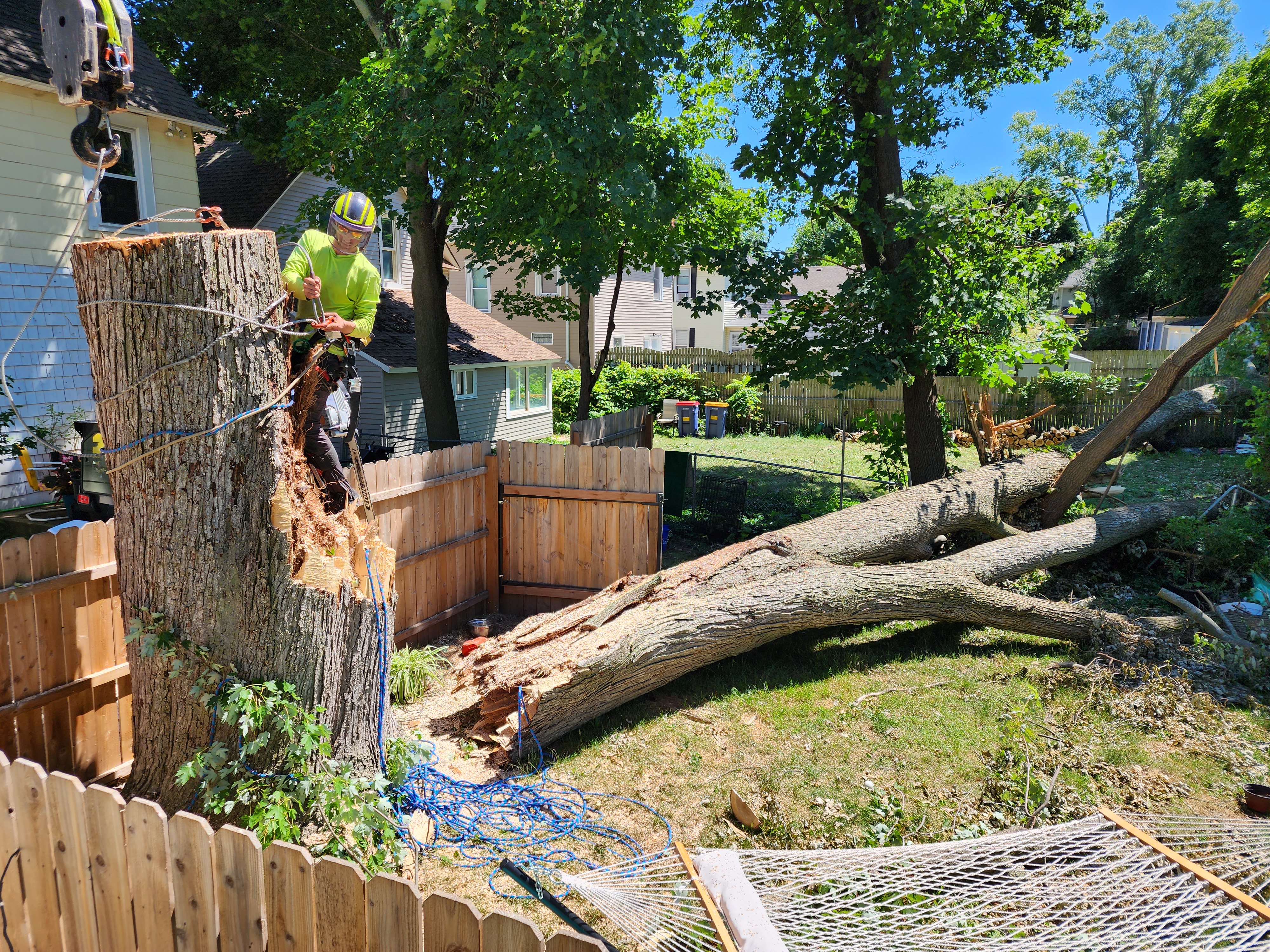
It's Not Always an Obvious Call
One of the most common conversations we have with homeowners starts the same way: "I've got this tree — should it come down, or can we save it?"
It's a fair question, and usually the honest answer is that it depends. The decision to remove or preserve a tree involves more factors than most people realize — and the right call isn't always the most obvious one. We've seen trees that looked terrible but responded well to treatment, and trees that looked fine but had hidden defects that made them genuinely dangerous.
Here's the framework we use when evaluating that decision for homeowners across the Grandville and Greater Grand Rapids area.
The Case for Preservation
Mature trees are irreplaceable on any human timeline. A 60-foot oak or maple took 40 to 80 years to reach that size. You can plant a replacement, but you won't see the same canopy coverage, shade, or property value benefit for decades. When a tree can be reasonably preserved, the long-term value almost always justifies the effort.
Preservation is usually the right direction when:
- The tree is structurally sound. Even if it has cosmetic issues — deadwood, some canopy thinning, minor bark damage — the fundamental structure may be solid. Structural pruning, deadwood removal, and targeted care can address the visible problems without removing the tree.
- The issue is treatable. Many pest and disease problems have effective treatments if caught early enough. Emerald ash borer, for example, can be managed with trunk injection if the canopy hasn't declined past the point of recovery.
- The defect can be supported. Codominant stems, heavy lateral limbs, and weak branch unions don't automatically mean removal. Cabling and bracing systems can provide structural support that significantly reduces the risk of failure while keeping the tree intact.
- The tree has high value. Value isn't just monetary — though mature trees do add real dollars to property appraisals. It's also shade, privacy screening, wildlife habitat, and the character of the property. These factors deserve weight in the decision.
The Case for Removal
We never recommend removal as a default. But there are situations where it's clearly the right call — and waiting only makes things more dangerous and more expensive.
Removal is usually the right direction when:
- The tree is structurally compromised beyond repair. Extensive trunk decay, severe root damage, or a combination of defects that can't be mitigated through pruning or cabling. When the remaining sound wood can no longer support the tree's weight under wind load, the math changes.
- The tree poses an unacceptable risk. Location matters enormously. A declining tree in the back corner of a large lot is a very different situation than the same tree over a bedroom, a driveway, or a play area. Risk assessment considers both the likelihood of failure and what would be affected if it failed.
- Treatment isn't viable. Some conditions — advanced oak wilt, severe EAB damage with more than 50% canopy loss, extensive root rot — have passed the window where treatment can succeed. Continuing to invest in a tree that can't recover isn't good stewardship of your budget.
- The tree was already in decline before the triggering event. Storm damage to a tree that was already compromised by root damage, prior improper pruning, or chronic disease often tips it past the threshold. The storm revealed the problem — it didn't create it.
What We Evaluate During an Assessment
When we walk a property to help a homeowner make this decision, here's what we're looking at:
Structural Integrity
We examine the trunk, major branch unions, root flare, and canopy structure. We're looking for decay indicators (fungal fruiting bodies, cavities, soft bark), included bark at branch junctions, cracks, and any signs that the tree's load-bearing structure is compromised. Sometimes we use a sounding mallet to evaluate wood density in the trunk.
Canopy Health
What percentage of the canopy is alive and functioning? A tree with 70% live canopy has a very different prognosis than one with 30%. We look at leaf size, color, density, and whether dieback is progressing from the top down (often a sign of root problems or vascular disease).
Root Zone Condition
Root damage is often invisible from above ground — but it's one of the most critical factors. We check for construction damage within the drip line, soil compaction, grade changes, mushrooms at the base, and whether the tree has developed a lean that wasn't there previously.
Species and Site
Some species are more resilient than others. Some are more prone to specific failure patterns. And the site conditions — soil type, drainage, sun exposure, proximity to structures — all factor into how the tree is likely to perform going forward.
Risk and Target
A tree's condition only tells half the story. The other half is what's underneath it. A large dead limb over a woodland path is a very different risk than the same limb over a patio where your family eats dinner. We evaluate both the probability of failure and the consequences.
The Honest Middle Ground
Most of the trees we assess don't fall neatly into "definitely save" or "definitely remove." They're somewhere in between — and that's where experience and judgment matter most.
Sometimes the answer is: prune it now, cable the weak union, and reassess in two years. Sometimes it's: remove the worst tree and invest the budget in treating the two that are worth saving. Sometimes it's: the tree is fine, come back if anything changes.
The point is that the decision should be informed by a proper assessment — not by fear after a storm, not by a door-knocker with a chainsaw offering a deal, and not by assuming every big tree is a liability.
What We Recommend
If you've got a tree you're unsure about, here's our advice:
- Get a professional assessment. A certified arborist can evaluate the tree's structure, health, and risk level in a way that gives you real information to work with — not just a guess.
- Consider the full picture. Factor in the tree's value (shade, privacy, property value, aesthetics), the cost of removal versus treatment, and the long-term plan for your property.
- Don't wait on genuinely hazardous trees. If a tree is a clear safety risk — significant lean, major decay, dead limbs over high-traffic areas — the cost of proactive removal is always less than the cost of emergency cleanup and potential property damage.
- Think about what comes next. If removal is the right call, plan for replanting. Diversifying species across your property is the best long-term strategy for a healthy, resilient canopy.
We're happy to walk your property and talk through the options — no pressure, no obligation. Request a free assessment or call 616-947-4050.
Frequently Asked Questions
- How long does a mature tree take to replace if removed?
- It depends on the species, but most shade trees take 20 to 40 years to approach the canopy size of a mature tree that's been growing for 50+ years. Fast-growing species like red maples or tulip poplars fill in sooner, but they often have trade-offs in wood strength or longevity. This is one reason preservation is worth serious consideration when the tree is viable — you can't fast-track decades of growth.
- Can a tree that's been topped be saved?
- Often yes, but it takes time and corrective pruning over multiple seasons. Topping triggers dense clusters of weakly attached sprouts that are prone to breaking. A certified arborist can selectively thin and train these regrowth sprouts into a more stable structure — but the tree will never fully recover its original form. Prevention is always better than correction.
- What happens to the stump after a tree is removed?
- We can grind the stump down below grade level so it's no longer visible. Stump grinding produces wood chips that fill the hole and decompose over time. The root system gradually decays underground over several years. If you're planning to replant in the same spot, we can grind deeper and amend the soil to give the new tree a better start.
- Should I get a second opinion before removing a large tree?
- If you're uncertain, absolutely — and any reputable arborist will encourage that. A second set of trained eyes looking at the tree's structure and condition is never a bad idea, especially for large, high-value trees where removal is irreversible. Look for ISA Certified Arborists for both opinions, and compare not just the recommendation but the reasoning behind it.