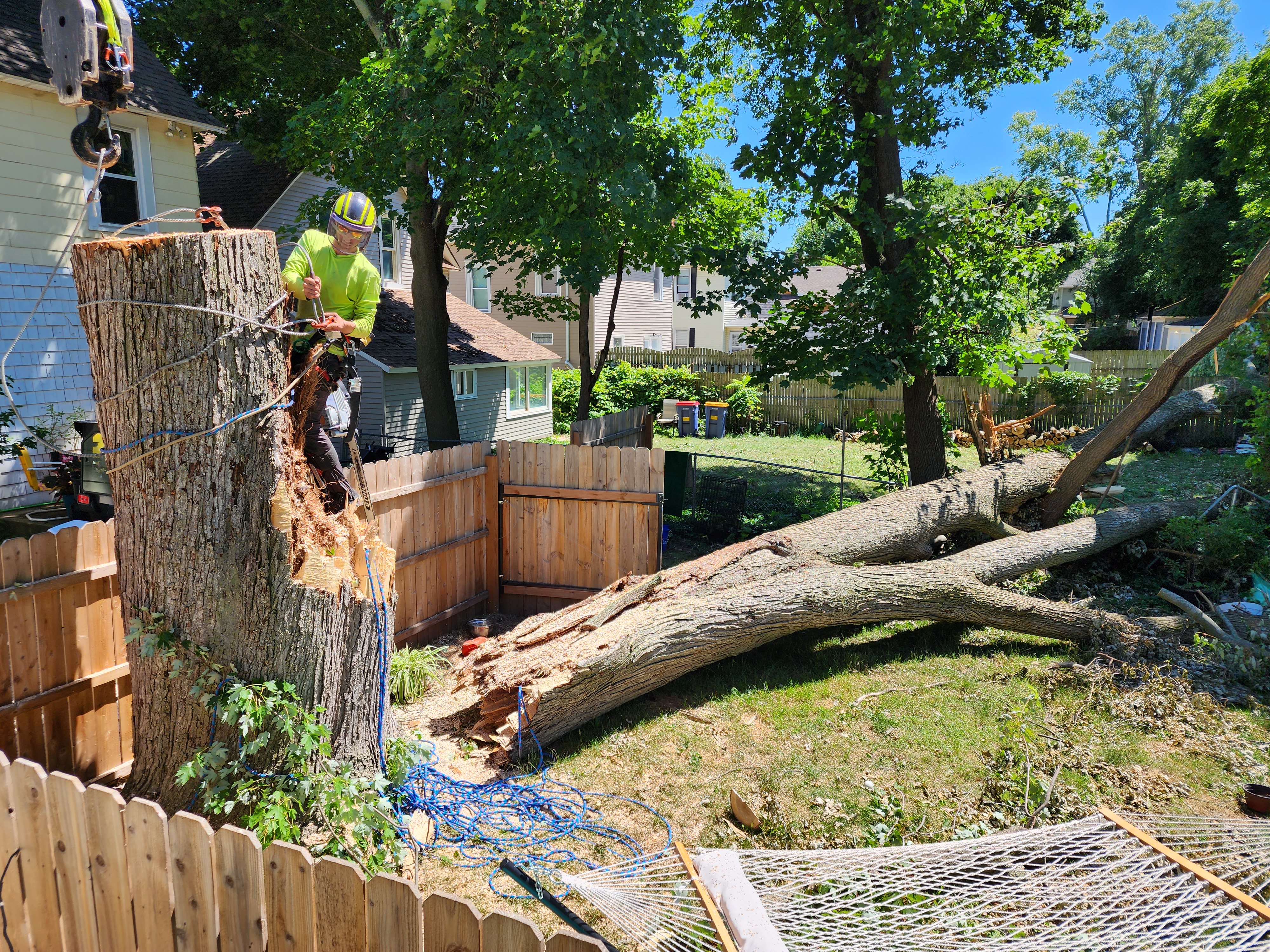
Some of the best trees in Kent County are also the riskiest. The big silver maple shading half the backyard, the estate oak that's been on the property longer than the house — these are exactly the trees people don't want to lose, and they're often the ones with a structural weak point quietly getting worse. That's where tree cabling and bracing comes in. As an ISA Certified Arborist (MI-4776A) working across Grand Rapids and the surrounding county, I get asked a lot whether hardware can save a tree that's starting to split. The honest answer: sometimes yes, sometimes no — and the difference comes down to what an inspection turns up before any cable goes in the tree.
What Cabling and Bracing Actually Are
People use "cabling" and "bracing" interchangeably, but they're two different tools that solve two different problems. Often we use them together on the same tree, but it's worth understanding what each one does.
Cabling
Cabling is a flexible support installed high in the canopy, between two or more limbs or stems. It limits how far those parts can move apart in wind and reduces the strain on a weak point below. A cable doesn't lock the tree rigid — it works up in the crown where the leverage is, catching the extreme movement that would otherwise pry a bad union open. Think of it as a seatbelt for the canopy, not a cast.
Bracing
Bracing uses rigid steel rods installed through the wood, usually across a crack or a weak fork, to hold the two sides together directly. Where a cable manages movement from above, a brace resists the forces trying to spread a union apart right at the union itself. On a tree with a split that's already started, bracing rods stabilize the immediate defect while cables higher up take the wind load off it. This whole approach is governed by the ANSI A300 (Part 3) standard for supplemental support systems, which is the professional benchmark we install to.
When Cabling Is the Right Call — and When It Isn't
Not every tree is a candidate, and I'd rather tell you that up front than sell hardware for a tree that can't be made safe. Cabling makes the most sense when a structurally valuable tree has a specific, fixable weak point — a codominant fork, a heavy horizontal limb, a union with included bark — but the wood around it is still sound and the tree is otherwise healthy.
Where it doesn't work is when the problem is the whole tree, not one union. If the main trunk is hollow, extensively decayed, or the roots are failing, no amount of cable and rod will hold compromised wood together. Hardware anchors have to bite into solid wood to do anything; drive them into punky, rotten wood and you've created a false sense of security. That's why the first step is always a hands-on assessment of the trunk and union integrity — sounding the wood, checking for decay, looking at the geometry of the defect — before I'll recommend a support system. It's the same evaluation logic behind the broader question of tree removal vs. preservation: save what can be safely saved, remove what can't.
How We Install a System
Cabling is a climbing and rigging job, start to finish. There's no way to place an anchor correctly from the ground, so our crew climbs the tree or works from a tracked spider lift when the terrain and canopy call for it. Reaching the right height matters: a cable set too low doesn't have the leverage to control canopy sway, and a brace rod placed in the wrong spot can do more harm than good. Placement is most of the skill in this work.
Dynamic vs. Static Cable Systems
There are two families of cabling hardware, and we choose based on the tree.
- Dynamic synthetic systems use a strong, slightly stretchy synthetic rope installed without drilling into the tree. They allow a controlled amount of natural movement, which keeps the tree building reaction wood and adapting to wind — a good fit for many otherwise-healthy trees with a moderate weak point.
- Static steel-cable systems use extra-high-strength steel cable anchored to hardware set into the wood. They allow far less movement and carry higher loads — the right choice for a large stem or a serious defect where you need to firmly limit how far things can travel.
Through-Bolt Bracing Rods
When a union has already cracked or shows included bark that's actively splitting, we install threaded steel bracing rods straight through the stems and secure them on both sides. These through-bolt rods work in tension and compression to keep a cracked fork from spreading further, and they're almost always paired with cables above to take the wind load off the repair. Hardware sizing, spacing, and placement all follow the A300 standard so the system is doing what it's supposed to do and nothing it shouldn't.
The Kent County Trees We Cable Most
The trees I end up cabling in this county follow a pattern, because our neighborhoods and our weather push certain species toward the same failure. In the postwar neighborhoods across Grand Rapids, Kentwood, and Wyoming, it's the mature silver maples — fast-growing, often planted decades ago, and famous for codominant stems with included bark tucked into a tight V-shaped fork. That bark seam is a built-in weak point, and once a big silver maple gets tall enough to catch real wind, that fork is exactly where it wants to split.
Out east in Ada, Cascade, and the Forest Hills area, it's more often the big estate red oaks and white oaks — magnificent trees with heavy horizontal limbs reaching out over driveways, roofs, and lawns. Those long limbs carry a lot of leverage, and a well-placed cable can take real strain off a union that's carrying more weight than it was built for. (Worth noting: cabling and bracing is hardware work, not pruning, so it's fine to install on oaks year-round — it falls outside the summer oak-pruning window we hold to for disease reasons.)
Then there's West Michigan weather. Our trees get worked over by wet, heavy spring snow that loads limbs far beyond a dry snowfall, and by the straight-line winds that come through with summer storms and can put steady sideways pressure on a canopy for minutes at a time. Both are exactly the loads a good support system is designed to help manage. If a tree already shows the warning signs, our guide to the signs a tree won't survive the next storm is a useful gut check before the next front rolls in.
Inspection: Cabling Isn't Set-and-Forget
A support system is not a permanent fix you install once and forget. The tree keeps growing, keeps moving, and keeps adding wood around the anchors, so the hardware needs eyes on it over time. We recommend a professional inspection once a year, and again after any major storm. Over the years, cables can loosen or corrode, anchors can become undersized as the trunk thickens around them, and a defect can progress despite the support. Catching those things early is the whole point — ongoing monitoring is part of doing cabling responsibly, not an upsell tacked on afterward.
What It Costs
Cabling is one of the more affordable ways to keep a valuable tree, especially compared to removing and replacing a mature specimen. Most residential cabling jobs in the Grand Rapids area land somewhere between roughly $300 and $1,200. A single dynamic cable in a mid-size maple sits at the low end; a large estate oak needing multiple steel cables plus through-bolt bracing runs higher. Tree size, number of cables and rods, and how tough the canopy is to access all move the number. I don't give fixed quotes over the phone because I haven't seen the tree yet — every one is different. What I do offer is a free on-site estimate, where I assess the tree and give you a straight recommendation, whether that's cabling, pruning to reduce load, or something else.
When Removal Is the Safer Call
I'll always try to save a tree that's worth saving and can be made reasonably safe. But there's a line, and part of doing this honestly is knowing where it is. When the trunk is hollow or heavily decayed, when the roots are compromised, when a split has already torn deep into solid wood, or when the tree is leaning over something it absolutely can't be allowed to hit, cabling isn't the answer — it just delays a failure while masking the risk. In those cases removal is the safer, more honest call, and I'll tell you so.
The right move always starts with a look at the actual tree. If you've got a mature tree in Kent County with a fork that worries you, a big limb over the house, or a crack you've been watching get longer, let's take a look before the next storm makes the decision for you. We handle cabling and bracing across Grand Rapids and throughout the county — including Cascade, Ada, Kentwood, and Wyoming. Call 616-947-4050 or request a free estimate, and I'll come out, assess the tree, and give you a straight answer.
Frequently Asked Questions
- Does cabling save a split tree?
- Cabling can help a tree with a weak or partially split union, but it is not a guarantee. When the split is caught early and the wood is otherwise sound, a properly placed cable or brace rod reduces the load on that union and can extend the safe life of a tree worth keeping. Once a stem has torn deep into solid wood or decay has set in, cabling usually cannot make the tree safe, and removal is the better call. An arborist has to inspect the union first.
- How much does tree cabling cost in Grand Rapids?
- Most residential cabling jobs in the Grand Rapids area fall somewhere between about $300 and $1,200, depending on tree size, how many cables or brace rods are needed, and canopy access. A single dynamic cable in a mid-size maple sits at the low end; a large estate oak needing multiple steel cables plus through-bolt bracing runs higher. Every tree is different, so we give a free on-site estimate rather than a phone quote.
- How long do tree cables last?
- A well-installed cabling system typically lasts several years, but it is not permanent hardware. Synthetic dynamic cables and steel systems both need periodic inspection because the tree keeps growing and moving around the anchors. We recommend a look every year and after any major storm. Hardware can loosen, corrode, or become undersized as the tree adds wood, so ongoing monitoring is part of responsible cabling, not an optional extra.
- Is cabling better than removing the tree?
- It depends entirely on the tree. Cabling makes sense when a structurally valuable tree has a fixable weak point but is otherwise healthy and sound. It does not make sense when the trunk is hollow, heavily decayed, or already failing, because hardware cannot hold compromised wood together. A certified arborist weighs the tree's condition, its target zone, and your goals before recommending cabling, pruning to reduce load, or removal.